The Lost Buildings of Hexham
From the Gem Picture House that burned down to the vanished tanneries of Gilesgate, the demolished House of Correction and the old tenements cleared for Beaumont Street, here are the Hexham landmarks that time and the demolition men took away.
For all that Hexham has kept, plenty has been lost. Old cinemas have burned and closed, whole industries have vanished from the streets that once housed them, and slum clearances and civic improvements swept away buildings that earlier generations knew well. Some survive only in photographs and street names; others have been so thoroughly rebuilt that you would never guess what stood there before. Here are some of the Hexham landmarks that time, fire and the demolition men took away.
The Gem Picture House
Long before Hexham had its handsome Art Deco cinema, film-goers went to the Gem. The Gem Picture Palace opened on Hallstile Bank in the summer of 1909, one of the earliest cinemas in the town. Its first incarnation was short-lived: on 10 August 1914 it was destroyed by fire. The site was rebuilt and reopened around 1918 as the Gem Palace, with seating for about 450, and it served the town for years before the coming of the grander picture houses eventually left it behind.
Best for: Best for a reminder of early cinema: Hexham was watching films within a decade of the medium being invented.
The old Forum interior
Even the town's best-known cinema is, in part, a lost building. The Forum Cinema opened on the Market Place on 23 August 1937 as a spectacular Art Deco picture palace seating over 1,000, complete with panels depicting Roman charioteers on either side of the screen. It closed as a single grand auditorium in 1974. In the years that followed the building was carved up horizontally, with a bingo hall in the former stalls and a smaller cinema in the old balcony. Part of it later became the Forum pub, which preserves the sweeping staircase and panoramic windows, while an independent cinema still operates upstairs. The great single-screen auditorium of 1937, though, is gone for good.
The tanneries of Gilesgate and Cockshaw
Perhaps the biggest loss is an entire industry. For more than a century Hexham was a leather town, and the burns around Gilesgate and Cockshaw were lined with tanneries and glovers' workshops preparing hides and stitching the famous Hexham Tan gloves. At its height in the 1820s the trade employed well over a thousand people. The tanneries themselves have vanished, along with the crowded courts and yards where the gloveresses worked, and the area was later cleared of its slum housing. All that remains are street names such as Tanners Row, and the name of a pub on Gilesgate that recalls the trade.
The House of Correction
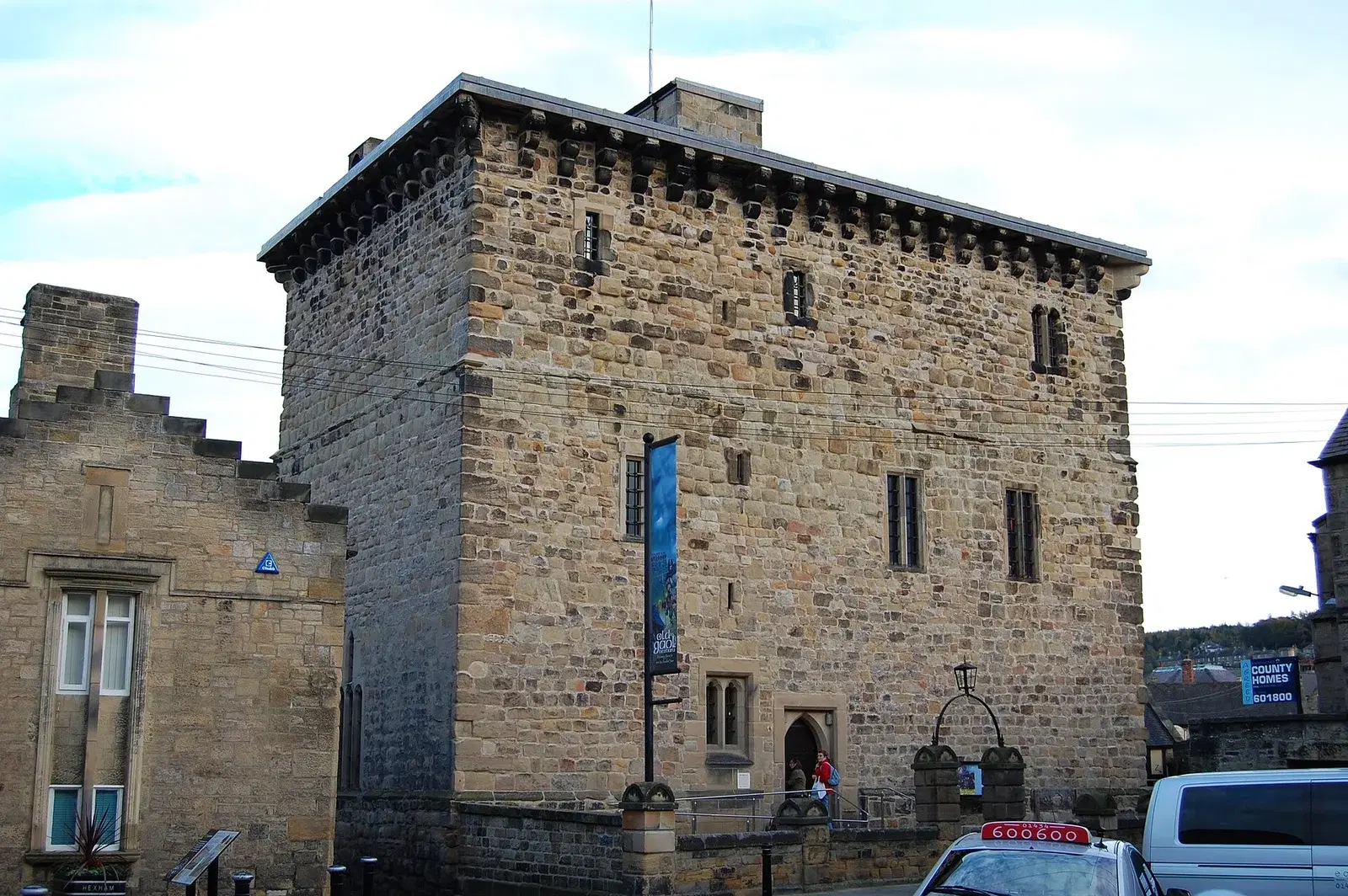
Hexham's medieval Old Gaol still stands, but its later companion does not. A separate House of Correction was opened in the town in 1784 to hold and set to work petty offenders and vagrants, part of the wider Georgian enthusiasm for reforming prisons. It served the town for well over a century but was largely demolished around 1962, leaving the far older gaol on Hallgate as the sole survivor of Hexham's long history of imprisonment.
The tenements cleared for Beaumont Street
Some of Hexham's lost buildings were sacrificed for improvement rather than neglect. When Beaumont Street was laid out in the 19th century, older tenement buildings were demolished and a wooded area to the west of the Abbey wall was cleared to make way for it. The result is the broad, dignified street that now carries the Queen's Hall Arts Centre, built in 1866 as the town hall and corn exchange. The gain was a fine civic frontage; the loss was a tangle of older housing that had grown up beside the Abbey over the centuries.
Reading the town for what has gone
Hexham rewards a slow walk with an eye for absence. A pub name on Gilesgate, a lane still called Tanners Row, the blank space where the House of Correction once stood, the subdivided shell of a 1930s cinema: each is a marker for something that has disappeared. Taken together they tell the story of a market town that has constantly remade itself, shedding old trades and old buildings while keeping enough of its fabric to remain unmistakably Hexham.
Frequently asked questions
What happened to Hexham's Gem cinema? The Gem Picture Palace opened on Hallstile Bank in 1909 and was destroyed by fire on 10 August 1914. It was rebuilt and reopened as the Gem Palace around 1918 with seating for about 450, an early rival to the later Forum cinema on the Market Place.
Is the old Forum cinema still standing? The Forum building on the Market Place survives, but its original 1937 form does not. The grand single-screen Art Deco auditorium closed in 1974 and was later subdivided. Part of the building is now the Forum Wetherspoon pub, which keeps the original staircase and windows, while an independent cinema still operates in the building.
What was Hexham's House of Correction? The House of Correction was a Georgian institution opened in 1784 to hold and set to work petty offenders and vagrants. It served the town for well over a century before being largely demolished around 1962, leaving the far older medieval Old Gaol on Hallgate as the surviving reminder of Hexham's penal history.
Have a suggestion? Get in touch.
Never miss what’s on
Join the weekly Hexham.live digest — the best events, news and local tips, straight to your inbox. Free, one email a week.
What's On
Family Glow Play Zone, Queen's Hall
11:30 AM · Queen's Hall Arts Centre, Beaumont Street, Hexham NE46 3LS
Cara Dillon, Queen's Hall
7:30 PM · Queen's Hall Arts Centre, Beaumont Street, Hexham NE46 3LS
Hexham Abbey Festival of Music & Arts 2026
Various · Hexham Abbey, Beaumont Street, Hexham NE46 3NB