The History of Hexham's Shopping Streets
How Hexham's shopping quarter grew from Saxon hamlets into a busy market town. The story of the Market Place and Shambles, Fore Street, Priestpopple, Battle Hill, Hencotes and St Mary's Chare.
Hexham does not have a single high street. Instead it has a cluster of ancient streets and chares that wind out from the Market Place, each with its own name, character and story. Fore Street, Priestpopple, Battle Hill, Hencotes and the narrow lanes of St Mary's Chare and Gilesgate together form one of the most characterful shopping quarters in the North East. Their odd names are not accidents: they record the hamlets, trades and events that shaped the town over more than a thousand years. Here is how Hexham's shopping streets came to be.
From Saxon hamlets to a market town
Hexham grew up around the monastery founded by St Wilfrid in 674 AD, and much of the town's shape still reflects that origin. The modern name is thought to derive from Hextildesham, in use from the late 12th century, and the settlement itself formed as three separate hamlets, Cockshaw, Priestpopple and Hencotes, gradually merged around the Market Place beneath the Abbey. That is why the town centre feels like a knot of streets rather than a single planned thoroughfare: it is really several old communities grown together over the centuries.
The Market Place and the Shambles
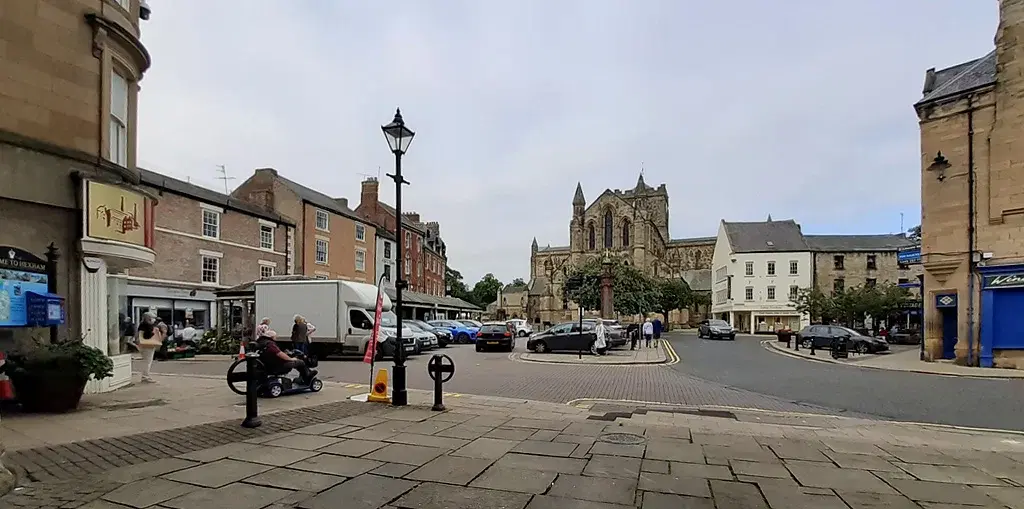
The heart of it all is the Market Place, overlooked by Hexham Abbey and the medieval Moot Hall gatehouse. Markets have been held here for centuries, and the square is still the focus of the town's weekly market. Its most distinctive survival is the Shambles, a Grade II* listed covered market erected in 1766 by Sir Walter Blackett, the owner of the Hexham estate. Built with stone columns on its outer sides and timber posts within, it was designed as a sheltered spot for traders, and market stallholders still use it today. Facing the square is the former Forum cinema, now the Forum, a 1937 Art Deco building whose name nods to the town's Roman past.
Best for: Best for a sense of the old town: stand in the Market Place with the Abbey, the Moot Hall and the Shambles all in view.
Fore Street and the chares
Running north from the Market Place is Fore Street, historically one of the town's principal shopping streets, paired with Back Street behind it. Off these lanes branch the chares, a local word for narrow alleys, including St Mary's Chare, sometimes known as Back Street, and Old Church Chare. These tight, pedestrian-friendly lanes are lined with small shopfronts and remain a favourite for independent traders. Among them is Cogito Books, a well-loved independent bookshop on St Mary's Chare, exactly the kind of specialist shop that has always suited Hexham's intimate street pattern.
Priestpopple and Battle Hill
To the south and east, the main route through the town changes its name as it goes, running through Priestpopple and Battle Hill before continuing on. Priestpopple was one of the original hamlets that merged to form Hexham, and its name recalls the priests of the medieval monastery who once held land here. Battle Hill is often linked in local tradition to the town's turbulent past, and today the stretch is a busy mix of shops, cafes and businesses. This eastern approach became increasingly important as the town grew, and it remains one of Hexham's principal commercial streets.
Hencotes and the western streets
On the western side of the town, Hencotes was another of the founding hamlets, and its name survives as a street running along the edge of the old town near the Sele. Nearby, Beaumont Street was laid out in the 19th century when older tenements and a wooded area beside the Abbey were cleared, opening up the grand civic frontage that includes the Queen's Hall. This mix of ancient lanes and later Victorian improvements gives Hexham's centre its layered feel, medieval chares in one direction, planned Victorian streets in another.
A shopping quarter that has kept its character
What makes Hexham's streets special is how much they have held onto. Many towns lost their old shopping lanes to post-war redevelopment, but Hexham's Market Place, Shambles, Fore Street and chares survive largely intact, filled with independent shops, cafes and long-standing businesses. Even the town's entertainment has deep roots: the independent Forum Cinema traces its site back to the early picture houses of the town. Walk the streets today and you are following routes that shoppers have used for the better part of a thousand years.
Frequently asked questions
Why does Hexham have so many oddly named streets? Hexham grew from three separate Saxon hamlets, Cockshaw, Priestpopple and Hencotes, which gradually merged around the Market Place beneath the Abbey. Several street names, including Priestpopple and Hencotes, preserve the names of those original settlements, while narrow lanes called chares, such as St Mary's Chare, use an old local word for an alley.
What is the Shambles in Hexham Market Place? The Shambles is a Grade II* listed covered market in the Market Place, built in 1766 by Sir Walter Blackett. It has stone columns on its outer sides and timber posts within, and it was designed to give traders shelter. Market stallholders still use it today.
What are Hexham's main shopping streets? The main shopping streets radiate from the Market Place and include Fore Street, Priestpopple and Battle Hill, along with the narrow chares such as St Mary's Chare. Between them they hold a mix of independent shops, cafes and businesses, and the weekly market still fills the Market Place.
Have a suggestion? Get in touch.
Never miss what’s on
Join the weekly Hexham.live digest — the best events, news and local tips, straight to your inbox. Free, one email a week.
What's On
Family Glow Play Zone, Queen's Hall
11:30 AM · Queen's Hall Arts Centre, Beaumont Street, Hexham NE46 3LS
Cara Dillon, Queen's Hall
7:30 PM · Queen's Hall Arts Centre, Beaumont Street, Hexham NE46 3LS
Hexham Abbey Festival of Music & Arts 2026
Various · Hexham Abbey, Beaumont Street, Hexham NE46 3NB