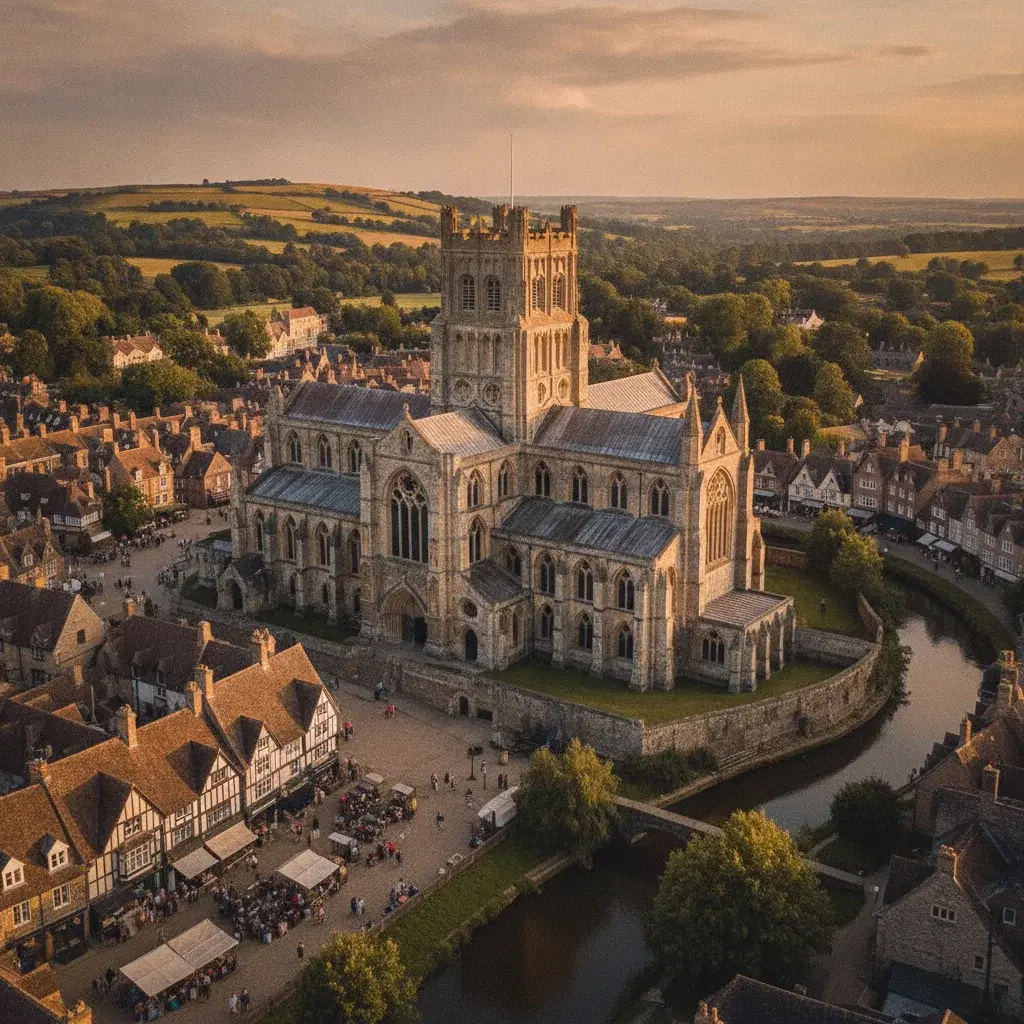
History of Hexham
From St Wilfrid's Saxon abbey to the Border Reivers, the Battle of Hexham, and the arrival of the railway, 1,300 years of history.
From Roman Shadow to Market Town: The Story of Hexham
Few towns in northern England carry as much history per cobblestone as Hexham. Perched above the South Tyne on the edge of what was once the most contested frontier in Britain, Hexham has been abbey town, Viking target, Lancastrian stronghold, Border Reiver stronghold, and Georgian market centre. Its story reaches back more than thirteen centuries, and it is still unfolding.
Anglo-Saxon Beginnings: St Wilfrid and the First Abbey
Hexham's recorded history begins in AD 674, when Etheldreda, Queen of Northumbria, granted a large estate here to Wilfrid, first native Saxon to serve as Bishop of York. Wilfrid built what contemporaries described as one of the finest churches in Britain, drawing on Roman cut stone hauled from the ruins of Hadrian's Wall and the nearby fort at Corbridge. By around AD 680 an imposing stone church, possibly a hundred feet long and built by continental masons to a basilica plan, dominated the landscape.
Of that original structure, only the Saxon crypt survives intact beneath today's abbey floor. It remains one of the oldest intact rooms in Britain. A single other relic endures above ground: the Frith Stool, a solid throne-like seat of carved sandstone, probably fashioned for Wilfrid himself, which later served as a place of sanctuary where criminals who reached it could not be seized until the abbey had guaranteed them fair treatment.
Viking Raids and Dark Centuries
The prosperity of Wilfrid's abbey made it a target. Viking raiders attacked Hexham in 793 AD, the same year the famous assault on Lindisfarne announced the Viking age to the Christian world. The Hexham community was devastated, its monks scattered, and the great church fell into ruin. For the better part of three centuries the town existed in the shadow of what it had once been.
Medieval Revival: Market, Gaol, and Moot Hall
Recovery came gradually with Norman rule. In 1113, Archbishop Thomas II of York refounded the church as an Augustinian priory, beginning a centuries-long rebuilding that produced the nave and transepts that stand today. The town grew around the priory's influence.
In 1239 Hexham was granted a market charter, establishing the regular trading that remains a heartbeat of the town to this day. The medieval townscape gained two of its most striking monuments: the Old Gaol, completed in 1333 at the order of Archbishop William Melton and built from Roman stone salvaged from Corbridge, became the earliest recorded purpose-built prison in England; and the Moot Hall, commissioned around 1379, survives as one of the finest medieval courthouses in the north.
Between these building projects, Hexham suffered further violence. In 1297 William Wallace burnt the town during his devastating raids into Northumbria.
The Battle of Hexham, 1464
The Wars of the Roses gave Hexham one of its most dramatic moments. On 15 May 1464, a Yorkist army under John Neville, Lord Montagu, intercepted Lancastrian forces led by Henry Beaufort, Duke of Somerset, in meadows near Linnels Bridge beside the Devil's Water stream, a few miles south of the town.
Lord Montagu's men charged down Swallowship Hill and crushed the Lancastrian position. Somerset was captured and beheaded almost immediately. The battle effectively ended Lancastrian resistance in the north and brought five years of relative peace to the Wars of the Roses.
The Liberty of Hexhamshire and the Border Reivers
Throughout the medieval and early modern period, Hexham occupied a peculiar constitutional position. Hexhamshire was a Liberty, a semi-autonomous jurisdiction governed not by the Crown but by the Archbishop of York. Exempt from many royal and county oversight mechanisms, it had its own courts, its own sheriff, and its own coroner. This status persisted until an Act of Parliament absorbed Hexhamshire into Northumberland in 1572.
The Liberty's distinctive governance made Hexham the administrative centre of the English Middle March, the borderland zone where law was often whatever the strongest local family chose it to be. From the 13th to the 17th centuries, English and Scottish Reiver families raided across this landscape, stealing livestock, burning farmsteads, and extracting protection money. The Old Gaol on Hallgate regularly held captured Reivers awaiting rough justice. In 1538, a band of Reiver horsemen broke into the Gaol itself, freeing imprisoned companions in a single audacious raid.
Georgian and Victorian Growth
Peace, when it came, brought prosperity. Horse racing at Hexham is recorded from 1793, and the racecourse on the high ground above the town became a fixture of the social calendar. The most transformative event of the 19th century was the arrival of the railway: on 9 March 1835 passenger services opened between Blaydon and Hexham on the Newcastle and Carlisle Railway, making Hexham station one of the oldest purpose-built railway stations in the world. The railway opened Hexham to wider trade and tourism, and the town's Victorian expansion gave it the prosperous market-town character it largely retains today.
Hexham Today
Modern Hexham is a thriving market town of around 11,000 people and the principal settlement of the Tyne Valley. The abbey, the Old Gaol, and the Moot Hall still stand within a short walk of each other, making the historic core one of the most concentrated groupings of medieval monuments in the north of England. The Tuesday market continues under the same charter granted in 1239. And the Saxon crypt beneath the abbey, built by Wilfrid's masons, survived the Vikings, survived the Reformation, still welcomes visitors who want to stand in a room that is more than 1,300 years old.
Local businesses mentioned
Never miss what’s on
Join the weekly Hexham.live digest — the best events, news and local tips, straight to your inbox. Free, one email a week.
What's On
Destination: Elton — The Hits of Elton John
7:30 PM · Queen's Hall Arts Centre, Beaumont Street, Hexham NE46 3LS
Hexham Farmers' Market (late October)
9:00 AM · Market Place, Hexham
Fleece to Fabric: The Textiles of Vindolanda
See booking · Roman Vindolanda, Chesterholm, Bardon Mill NE47 7JN