Hexham in World War Two
How a Tyne Valley market town lived through the Second World War, from evacuees off bomb-blasted Tyneside and the wounded of Dunkirk arriving at the emergency hospital to the Home Guard, the home front and the tragedies that touched Tynedale.
The Second World War reached Hexham differently from the way it reached the coast. This was not a port or a shipbuilding town within easy range of the Luftwaffe, but a small Tyne Valley market town, ringed by farms and moorland, twenty miles up the line from Newcastle. That distance largely spared it the bombing that fell on Tyneside, yet the war shaped daily life here as thoroughly as it did anywhere, from the evacuee children who arrived off the trains to the wounded who came back from France. This is a careful look at how Hexham lived through those years.
A safer town up the valley
For the authorities planning the defence of the North East, Hexham's very ordinariness was an asset. When the bombers came for the Tyne, they came for the coal staithes, the docks and the shipyards nearer the river mouth, not for a country town among the fields. As a result Hexham was designated a reception area, one of the safer places to which people could be sent from the dangerous districts nearer the coast.
That did not mean the war passed unseen overhead. Aircraft crossed the valley on their way to and from the coast, and one of the first direct brushes with the enemy was almost surreal in its ordinariness: a lone German aircraft came down low and machine-gunned the Bellingham to Hexham bus early in the war, a reminder that even a quiet rural road was not entirely beyond reach. For the most part, though, the townspeople experienced the air war as distant, watching and hearing the raids on Tyneside from a safer remove.
Evacuees off bomb-blasted Tyneside
The most visible change to the town was the arrival of the evacuees. From the cities of the North East, from Newcastle and Gateshead where the docks and factories made bombing a real threat, children were sent out to rural Northumberland, and the Tyne Valley took its share. Families across Tynedale opened their homes to youngsters who arrived frightened, far from their parents and, as local accounts frankly recall, occasionally louse-ridden after the journey out of the crowded terraces.
For the children it was a bewildering change, from tight city streets to a landscape of farms and open country. For their hosts it meant rearranging cramped households and adjusting to unfamiliar city ways. The experience was not always easy on either side, but it was one of the defining features of the home front here, and it wove the town more tightly into the wider war than its quiet setting might suggest.
The wounded of Dunkirk
If the reality of the fighting felt remote through the first months of the war, that changed sharply in the early summer of 1940. As the British Army was driven back to the Channel and evacuated from Dunkirk, scores of gravely wounded men began arriving at Hexham Emergency Hospital. Suddenly the war was not something happening across the sea but something being carried into the town on stretchers, and the medical staff and townspeople saw for themselves what the retreat had cost.
That moment brought home the seriousness of what lay ahead. The hospital, the volunteers and the town absorbed the shock and carried on, as communities across the country were learning to do, but the arrival of the Dunkirk wounded was long remembered as the point at which the distant war became unmistakably real in Hexham.
The home front and the Home Guard
Behind the front-line drama ran the steady grind of the home front. Rationing shaped every kitchen, the blackout brought its own dangers, with fatalities in the dark on roads that were hard enough by day, and men and women left the valley for the forces and for war work. Those who remained took on Civil Defence duties, first aid, fire-watching and the endless committee work of a country at war.
Older men and those in reserved occupations joined the Local Defence Volunteers, soon renamed the Home Guard, and Hexham formed its own platoon. Their duties were real, if unglamorous, guarding key points and standing ready against an invasion that thankfully never came. The service had its own costs: K.W.D. Hodgson, a popular local schoolmaster and Tynedale rugby player, was killed in an accident while serving with the Hexham platoon, one of several home-front losses that touched the town directly.
Tragedy in Tynedale
For all that it was spared the bombing, the wider district did not escape without loss, and the worst blows came not from the enemy but from the dangerous business of preparing for war. At Coanwood, to the west of Hexham, a training exercise went badly wrong and left around two dozen men dead or seriously injured, one of the grimmest single incidents on the Tynedale home front. At Hexham railway station an ammunition train exploded, killing three men, and elsewhere in the valley a runaway barrage balloon caused a fatality. These accidents, largely forgotten now, were tragedies as real as any caused by a bomb.
Remembering the war
Hexham's older buildings watched over all of it. The Grade I listed Hexham Abbey, with its Anglo-Saxon crypt and more than 1,300 years of history, stood at the centre of a town at war as it had stood through so much before, a place of worship and of remembrance through the darkest years. Nearby, the medieval Hexham Old Gaol on Hallgate, England's oldest purpose-built prison, was another link to a long past that the war generation was determined should have a future.
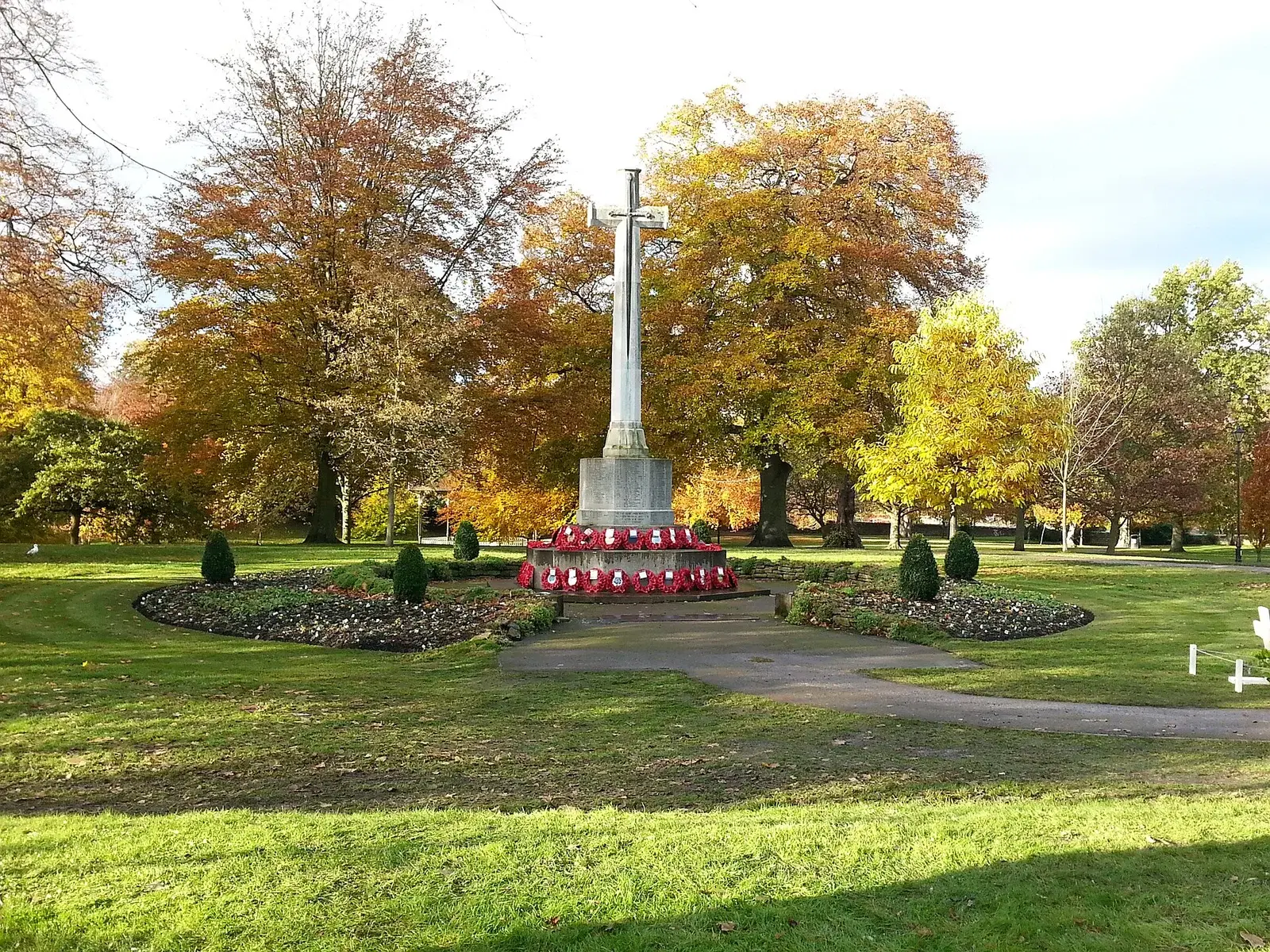
When peace came, the town remembered its own. The Northumberland Fusiliers' memorial gateway, first placed at the White Hart Inn on Fore Street after the First World War and later moved near the Abbey Grounds and the Sele, carries the weight of both conflicts, and the town's memorials continue to mark the fallen. Remembering those years accurately, without exaggeration and without forgetting the quiet losses as well as the loud ones, is the least a town can do for the people who lived through them.
Have a suggestion or a family memory of wartime Hexham? Get in touch.
Local businesses mentioned
Never miss what’s on
Join the weekly Hexham.live digest — the best events, news and local tips, straight to your inbox. Free, one email a week.
What's On
Family Glow Play Zone, Queen's Hall
11:30 AM · Queen's Hall Arts Centre, Beaumont Street, Hexham NE46 3LS
Cara Dillon, Queen's Hall
7:30 PM · Queen's Hall Arts Centre, Beaumont Street, Hexham NE46 3LS
Hexham Abbey Festival of Music & Arts 2026
Various · Hexham Abbey, Beaumont Street, Hexham NE46 3NB