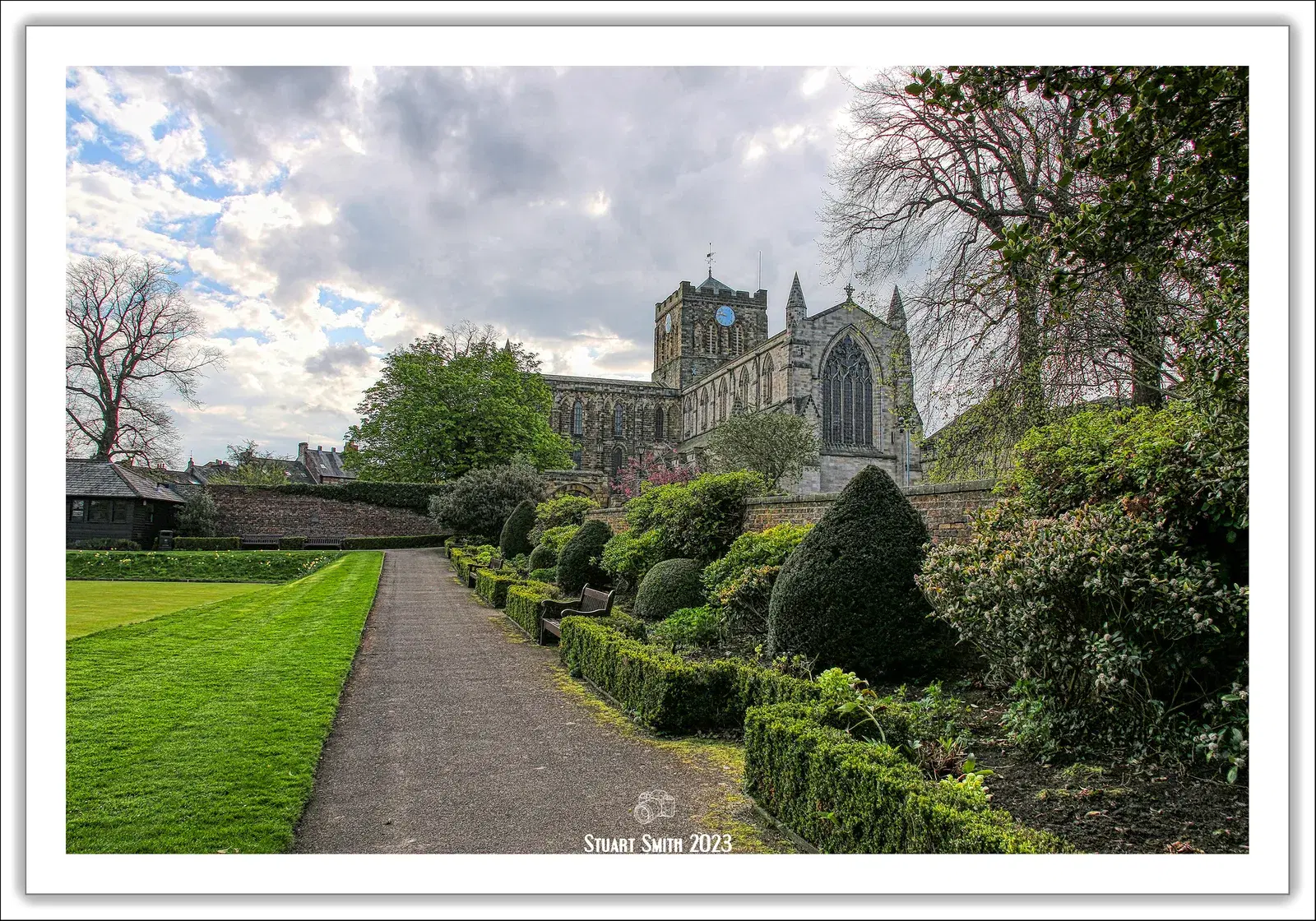
Hexham Abbey: The Complete Guide
A 1,350-year-old Saxon crypt, the Frith Stool, Acca's Cross, the Night Stair, and Dance of Death panels, everything you need to know about visiting Hexham Abbey.
One of England's Great Surviving Churches
Standing at the heart of Hexham, the Abbey has dominated this market town for more than 1,300 years. It began as one of the finest churches in Anglo-Saxon Britain, survived Viking destruction, was rebuilt as an Augustinian priory, and outlasted the Reformation to remain a living place of worship and one of Northumberland's most visited historic sites.
The Story of the Abbey
Anglo-Saxon Foundation, 674 AD
The Abbey's story begins with St Wilfrid, the first native Saxon to serve as Bishop of York. In 674 AD, Etheldreda, Queen of Northumbria, granted him a large estate at Hexham and Wilfrid built what contemporaries considered one of the most beautiful churches in the land. He drew on Roman dressed stone from the nearby fort at Corbridge, just three miles away, and may have employed continental masons working to a basilica plan.
Only one part of Wilfrid's original building survives: the Saxon crypt, still intact beneath the nave floor. It is one of the oldest intact rooms in Britain.
Destruction and Refounding
Viking raids devastated Hexham in 793 AD, the same year as the famous attack on Lindisfarne. The community scattered, the great church fell into ruin, and Hexham did not recover its religious importance for three centuries. In 1113, Archbishop Thomas II of York refounded the site as an Augustinian priory, commissioning the systematic rebuilding that produced the nave, transepts, and choir visible today.
The Reformation under Henry VIII dissolved the priory in 1537, but unlike so many religious houses the church itself was not demolished. It was retained for parish use. That pragmatic survival is what makes Hexham Abbey so remarkable: it is an essentially complete medieval priory church still in daily use.
What to See
The Saxon Crypt
The centrepiece of any visit. Wilfrid's crypt is reached by a steep stone stair descending beneath the nave floor, and it is as it was in his time. The low vaulted chambers are built from Roman stone. You can see the tool marks and some original Roman mouldings still on the blocks. It is a genuinely extraordinary experience to stand in a room that has survived intact for over thirteen centuries.
The Frith Stool
Standing in the choir, the Frith Stool is a solid carved sandstone throne that may date from Wilfrid's original foundation. Frith stools were places of sanctuary, any person who reached one, however serious their crime, could not be seized until the church had guaranteed them fair treatment and justice. It is possible that Wilfrid himself sat here.
Acca's Cross
Acca succeeded Wilfrid as Bishop of Hexham and served for 23 years before being buried here in 740 AD. The ornate memorial cross erected at his grave in the 8th century is a masterpiece of Northumbrian stone carving: the shaft is covered in wonderfully intricate vine scroll, swirling interlace that breaks into leaves and fruit. It stands today as one of the finest surviving examples of early medieval Northumbrian sculpture.
Roman Stones
The abbey is effectively a museum of Roman stonework. Near the foot of the Night Stair stands a nine-foot block of sandstone carved with a mounted Roman soldier. The inscription identifies him as Flavinus, a 1st-century standard-bearer in the Roman cavalry stationed at Corbridge. Dozens of other Roman stones are incorporated into the walls throughout.
The Night Stair
The Night Stair in the south transept is one of the most evocative survivals in any English church. Built early in the 13th century, its 35 stone steps rise steeply from the transept floor to what was once the canons' dormitory above. For centuries, the Augustinian community descended these stairs in darkness before dawn to sing the night offices. The steps are worn smooth by their passage. Hexham's is one of a tiny number of night stairs that survived the Dissolution. You can climb it today.
The Dance of Death Panels
Hexham holds one of the largest collections of medieval wooden panel paintings in the country. The most celebrated is the 15th-century Dance of Death sequence: four scenes showing Death as a gruesome skeleton wielding a sickle, leading in turn a cardinal, a king, an emperor, and a pope. Having survived the iconoclasm of the Reformation, these are among the finest examples to survive anywhere in England.
The Big Story Exhibition
The Abbey's modern visitor exhibition tells the 1,350-year story of the church and its community. The centrepiece is the Hexham Chalice, a tiny copper and gilt goblet used by Anglo-Saxon missionaries to celebrate the Eucharist. The exhibition is open daily and is included free with admission.
Practical Information
Hexham Abbey is in the centre of town, with parking nearby on Beaumont Street and at Wentworth car park. Entry is free. The Refectory Cafe is open 10am-4pm daily; the Gift Shop is open 11am-3pm daily.
The Abbey hosts concerts and events throughout the year, including the Hexham Abbey Festival of Music & Arts each September and a regular Lunchtime Live series of free recitals. Check hexhamabbey.org.uk for the current programme.
Local businesses mentioned
Never miss what’s on
Join the weekly Hexham.live digest — the best events, news and local tips, straight to your inbox. Free, one email a week.
What's On
Destination: Elton — The Hits of Elton John
7:30 PM · Queen's Hall Arts Centre, Beaumont Street, Hexham NE46 3LS
Hexham Farmers' Market (late October)
9:00 AM · Market Place, Hexham
Fleece to Fabric: The Textiles of Vindolanda
See booking · Roman Vindolanda, Chesterholm, Bardon Mill NE47 7JN